
Affinity Photo has become the first choice for photography and creative professionals around the world, who love its speed, power and precision. Born to work hand-in-hand with the latest powerful computer technology, it’s the only fully-loaded photo editor integrated across macOS, Windows and iOS. Affinity Publisher 1.8 is here, and as usual is free to existing users on the platform(s) you have purchased a license for. Read our handy guide—How to install Affinity updates—if you need any help updating. So what’s new in Affinity Publisher 1.8? This is a biggie. Affinity Publisher From books, magazines and marketing materials, to social media templates, website mock-ups and other projects, this next-generation publishing app gives you the power to combine your images, graphics and text to make beautiful layouts ready for publication. Was $49.99 Now only $24.99. § 230, which basically made all Internet service and content providers platforms as to their users’ speech—whether or not they blocked or removed certain kinds of speech.”. Compare Affinity Publisher vs Microsoft Publisher. 18 verified user reviews and ratings of features, pros, cons, pricing, support and more.
- Affinity Publisher Download
- Is Affinity Publisher Free
- Affinity Publisher Cost
- Affinity Publisher Cost Calculator
- Is Affinity Publisher Any Good
While we all await the advent of ePub format export in Affinity Publisher, the next best thing – or maybe even the best thing according to some, is to use PDF for Print. Affinity has a large number of PDF formats to export to.
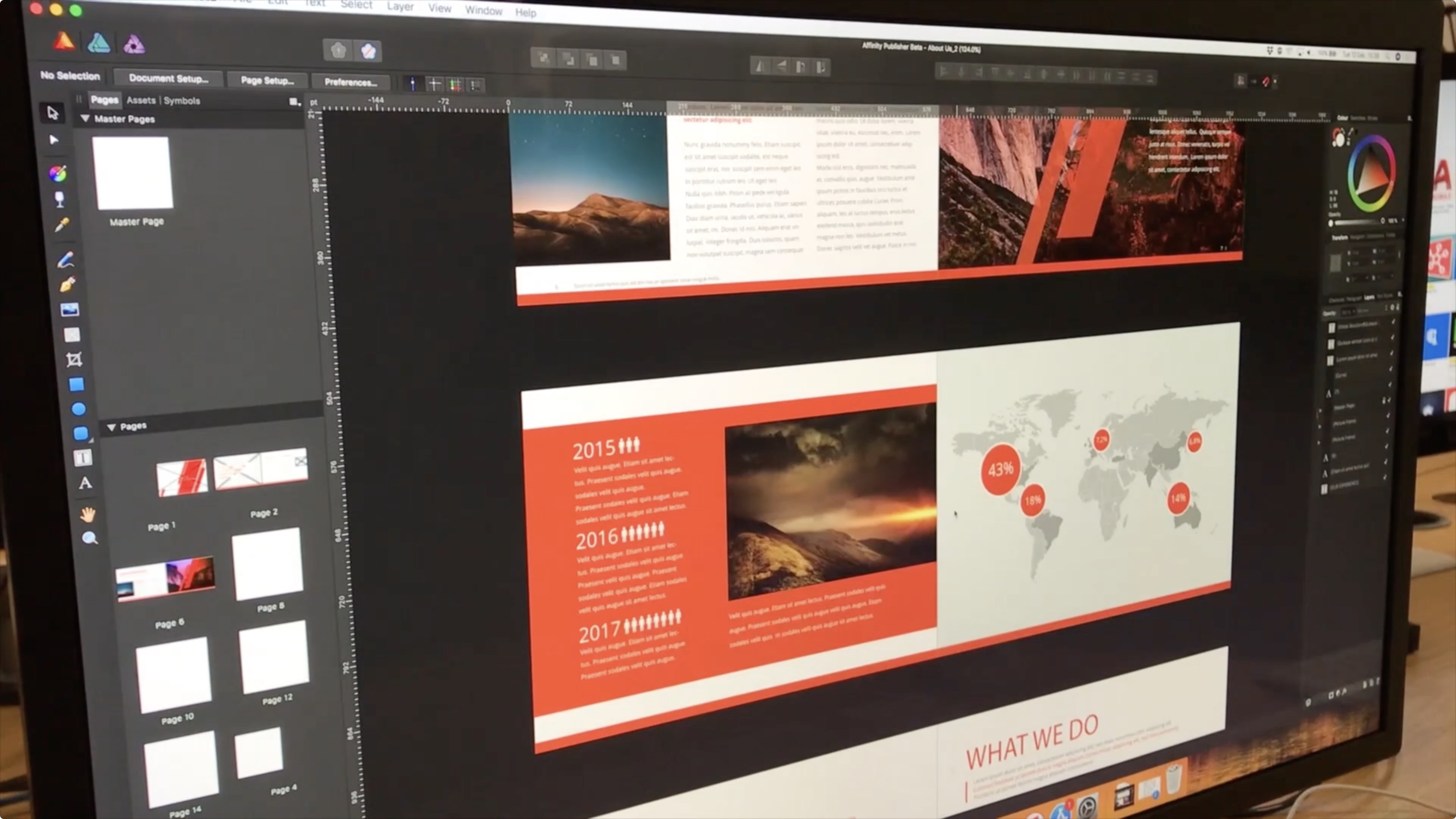
Which one do you want for your book? The answer to that is as varied as the number of print shops that are available. However… We won’t try and cover them all because it’s just too silly to try and do so.
If you need a particular PDF type for a particular job, you will most likely be told what it is you need.
But we can look at some broad meanings of the list that Affinity presents.
- Ingram Spark. PDF (.pdf) and EPUB (.epub).
- Amazon/Kindle Publishing.
Microsoft (DOC/DOCX)
Kindle Create (KPF)
HTML
Mobi
ePub
rtf
txt
pdf - KOBO. Use DOC/DOCX, OPF, ePub, Mobi
- Apple. Use Pages. They updated their system this year.
This useful link to a YouTube tutorial will show you how to convert a pdf file to an ePub file for free, using Google Docs. I can’t make any comments on its effectiveness. In fact, it may be more trouble than its worth.
To publish a PDF file you can follow the advice contained in the Affinity Publisher Help document. If you can find it. It’s well-hidden… Now they call the items in the drop-down list Presets. And I suppose they are. But it’s very detailed so worth the look. I reproduce them below.
- From the File menu, select Export.
- On the dialogue, select the PDF format option.
- Choose a Preset which include:
- PDF (for export)—Exports to PDF 1.7 (Acrobat 8) at document resolution, no image downsampling, overprint on, embed all fonts and use (and embed) document profile as colour space.
- PDF (for print)—Exports to PDF 1.7 (Acrobat 8) at 300 DPI, downsample images of >450 dpi, overprint on, embed all fonts, use (and embed) document profile as colour space, allow advanced features.
- PDF (for web)—Exports to PDF 1.7 (Acrobat 8) at 72 DPI, downsample images of >108 dpi, embed all fonts, and sRGB colour space.
- PDF (for flatten)—Exports to PDF 1.7 (Acrobat 8) at document resolution, rasterises all content, no image downsampling, overprint on, embed all fonts and use (and embed) document profile as colour space.
- PDF/X options are
P ro -print PDF presets that create PDF files that output to CMYK colour space and can embed all fonts.- PDF (PDF/X-1a:2003)—based on PDF 1.4, flattens transparency, no colour management
- PDF (PDF/X-3:2003)—As for PDF/X-1a:2003, but supports spot colours and allows colour management. RGB or CMYK images with attached colour profiles are supported.
- PDF (PDF/X-4)—As for PDF/X-3:2003, based on PDF 1.6, supports transparency
And this broadly all means the following.
- PDF (for export)
When you just want a PDF file to send to a friend, or the office team, or your editor to check over. This is what is generally floating around the internet, and almost anything will read it and print it. Can be quite large files. Everything is included as is. - PDf (for print)
When you want a document that is not so big, that contains images. It will downsample the images reducing them to smaller images of less than 450dpi if they are over that. A lot of professional images are. - For web—PDF files for web use are optimised for screen use, i.e. with downsampled images, document security, but without pre-press page marks, bleed, etc. Downsampling images leads to smaller documents for quicker loading.
- For Pro print use PDF/X—PDF files for professional printing are high-quality reproductions of your publication that are passed to a print partner (normally external to your company). You’ll typically require a CMYK document, printer marks, bleed, >300dpi images, and PDF/X-1a, PDF/X-3 or PDF/X-4 compatibility (for CMYK output).
- With PDF/X compatibility, all your publication’s colours will be output in the CMYK colour space, and fonts you’ve used will be embedded. A single PDF/X file will contain all the necessary information (fonts, images, graphics, and text) your print partner requires.
You should be aware, that if you are producing for eBooks. Like Kindle, Kobo, Nook, and Apple etc exporting in Print format is meaningless.
So let’s have a look at this, shall we? eBooks first. The Big Boy on the block is Kindle. So what do they have to say on the subject first?
We accept PDF files, but they can contain embedded formatting and/or images that don’t convert well to eBooks. If you’d like to upload a PDF file for your book, preview it before you publish. If you see any issues or if your book doesn’t look the way you want it to, we recommend converting your PDF to a Word document and formatting it according to our eBook Formatting Guide. You can also try using the Kindle Create. This is a downloadable tool that helps you convert PDFs that contain rich graphics like charts, graphs, and equations. Learn more about Kindle Create.
It mentions converting your document to a Word document. Well, that’s not absolutely necessary.
But – the biggest header there should warn you. PDF is last on the list in their eBook formatting guide. If you submit pdf for ebooks, you will almost certainly run into problems. Yes I know, ePub is not yet available in Affinity Publisher. There are certain rules to follow for ePub books though, and you can go a long way toward alleviating any problems you may have
p.s. Kindle Create is really cool. It works. Mac or Windows. If you are doing eBooks for Kindle/Amazon, I’d suggest that you can’t be without this tool.
Affinity Publisher Download
/article-new/2020/02/Affinity-Publisher-1.8-Live-Preflight-Checking.jpg?lossy "Affinity")
The most helpful thing you can do, prior to exporting for PDF for eBooks of any sort is to observe some basic Manuscript Formatting guidelines.
eBooks are at their root,
So to Manuscript Formatting.
- Set your paragraph indentations and line spacing.
Tabs don’t convert in Kindle so you need to use indentation.
Setfirst-line indentation to 5mm, or 0.2″
Line spacing is set to 0 pt before and Single line spacing - Format chapter titles.
Set your chapter titles to the HTML equivalent of Heading 1. In font speak, that’s 2em, weight Bold.
Alignment Center
Repeat for each chapter title. - Add front and back matter.
Front Matter includes Title, Copyright page, Dedication pages
Back matter can include the Authors page, and perhaps a bibliography. Back matter is not really necessary but most ebooks include it now. Look at books similar to yours and see what others do. - Add page breaks.
Adding page breaks ensures that your text displays as intended. So wherever you want a page to begin,
Place your cursor.
Go to the Insert option on your editor toolbar, and select Page Break. Don’t rely on just hitting the Return key. It doesn’t always work as you would expect. - You may be able to insert external links. Again, go to your insert option, having highlighted the text for the link, and insert a hyperlink. Not all ebooks allow external links within them…
When your PDF is properly formatted, you’ll avoid problems when reading your ePub file. The trick to creating a PDF file that converts properly into ePub is to set up the pages in a way that can be read by an e-reader and to use the word processor’s built-in formatting styles. Here are a few tips: For ePub, with the following settings you can hardly go wrong.
- Use styles to format headings, indented paragraphs, numbered lists, and bullet lists.
- Use page breaks when you intentionally want a page to stop at a particular spot. For example, at the end of each chapter.
- Choose an 8.5” x 11” page size with a portrait orientation and .5-inch margins.
- Left align or center align the paragraphs.
- Use a single font for the text. Recommended fonts are Ariel, Times New Roman, and Courier.
- Use 12 pt font size for body text and 14 pt to 18 pt for headings.
- Create images in JPEG or PNG format with a maximum size of 600 px tall and 550 px wide. Images should be in RGB color mode and 72 DPI.
- Do not wrap text around images. Use inline images where the text is above and below the image.
So, that’s the basics of formatting. There are a lot of other options that you could add. Adding images for example, table of contents, indexes and so on. That’s really for another tutorial.
Now to export your document from Affinity Publisher to PDF.
To a PDF most suitable for uploading to an ebook publisher, or using directly on a web page of sending to ebook readers directly.
If you are happy with your document in Publisher, click on Export in the toolbar.
Recall I mentioned that eBooks are based basically on the HTML format? That’s what used on the web pages on the internet, so if it looks good as a web document, it will almost certainly translate cleanly to an ebook. Let’s try, shall we?
Recall we are looking at a document to convert to an eBook. Most publishers like Kindle require flattened images, no transparent backgrounds to images and so on. So you have two options here.
- PDF (for web)
- PDF (flatten)
From the Affinity help file, they tell you this.
- PDF (for web)—Exports to PDF 1.7 (Acrobat 8) at 72 DPI, downsample images of >108 dpi, embed all fonts, and sRGB colour space.
- PDF (for flatten)—Exports to PDF 1.7 (Acrobat 8) at document resolution, rasterises all content, no image downsampling, overprint on, embed all fonts and use (and embed) document profile as colour space.
Because of the wide variation of acceptable document types accepted by third party ebook printers, like Kindle, Amazon, Kobo, Apple and so on, you may find you have to experiment.
If you don’t have any images, other than perhaps a cover image in some cases, then you are good to go. If you are distributing the document yourself as an ebook in pdf format, use the PDF (flatten) version because it doesn’t down sample the images. If your document is going to be read on the web use the PDF (for web) option.
When you are set, press enter.
PDF ( for web) results. In Adobe Reader.
This is the same document opened in Chrome.
The last view, opened in Kindle for Mac
So you can see just using the PDF is very versatile in any case. This version used the PDF (for web) option but it still works in most places. If you have images, I’d recommend PDF (flatten) instead. The images will be better quality. The web images will look terrible on devices. In fact on anything other than an internet web page. Generally, the text is not affected.
Exporting for Print
Here be Dragons. Take Warning.
There are so many printers it’s impossible to cover them all, but in all cases, the print house will tell you what your document specs must be. In most cases, Affinity will be able to be set to those specs,
As Affinity is still finding its way in the market place, you will find that most print houses still refer to Acrobat or InDesign specs for PDF files.
So where they may say – Ingram Spark for example:
Acrobat Distiller, Export from InDesign
PDF/X-1a:2001 or PDF/X-3:2002
You would use the Affinity export option. PDF/X-3-2003
This option allows you;
PDF (PDF/X-3:2003)—As for PDF/X-1a:2003, but supports spot colours and allows colour management. RGB or CMYK images with attached colour profiles are supported.
Click on the More tab on the bottom of the Export window to refine your selections.
This tutorial is not finished. However, there is enough here to get you started.
There are really two things to keep in mind.
1. If printing for eBooks and you want to use a PDF as your ebook file, use either (web) if on the internet only, or (flatten) if sending to eBook Readers.
If sending to someone like Kindle, use the (flatten) version, but make sure you check the results carefully before committing it.
2. If printing to send to a Print on Demand (POD) print firm or publishing house, then find out their preferred PDF format, which will most likely translate to the Affinity options listed below.
- PDF/X options are pro-print PDF presets that create PDF files that output to CMYK colour space and can embed all fonts.
- PDF (PDF/X-1a:2003)—based on PDF 1.4, flattens transparency, no colour management
- PDF (PDF/X-3:2003)—As for PDF/X-1a:2003, but supports spot colours and allows colour management. RGB or CMYK images with attached colour profiles are supported.
- PDF (PDF/X-4)—As for PDF/X-3:2003, based on PDF 1.6, supports transparency
From that point, it will produce a PDF document that you can open in the usual way – Adobe Reader. Check you book for mistakes, errors, wrong pages and all the rest. Often, seeing your book in another format will highlight things you have missed during your edit phase.
The Affinity Publisher is making a tough time to its competitors, especially for Adobe InDesign, and its unique attributes are filling the digital publishing space. Although it lacks certain features, the cost-effectiveness is enough to enter the market and stand against the industry giant – Adobe.

Read further and found out who is the winner in the Affinity Publisher vs InDesign duel.
About The Affinity Publisher
Serif released the full version of Affinity Publisher on June 2019, and it is running on a Mac OS and Microsoft Windows as well.
Publisher works like InDesign and being the part of Serif product line alongside with Affinity Photo, and Affinity Designer makes him a powerful tool, and with the use of the whole family, you can create any type of publishing media imaginable.
Affinity Publisher Making it Hard for InDesign
Tutorial Videos
The Affinity Publisher provides several tutorial videos for the beginners. They help you to understand the essential functions like setting a new document or adding the text etc.
If you are a new user or even an advanced one, you should watch the introductory videos to utilize the program to the maximum.
I cannot merely say that Affinity Publisher is a copy of InDesign. If you are familiar with Adobe InDesign, you would probably know how to set up the master spread, when designing a book or brochure.
The same feature is available in Publisher, but it works a bit differently than in InDesign, so you have to get used to its design process.
Is Affinity Publisher Free
Features And Workflow
If you are accustomed to the InDesign, you will immediately see the resemblance between the two. They both have similar tools and features, but the workflow of Publisher is relatively unique, and like with every new program, it takes some time to get used to it.
If you haven’t used InDesign before, you will find Affinity Publisher smoother to use because it has a better UX design compared to InDesign, which makes you find the desired functions with ease and fewer clicks.
Use For Different Media
Affinity designer is not limited only for the use of print media, but you can also use it for making online presentations, e-books, and if you’re a UX designer, you can neven use it for creating wireframes for apps or websites.
What About The Performance?
InDesign lacks in handling power of the workflow and is quite RAM thirsty. Especially users with slightly older computers or the ones who make designs on a laptop can definitely feel how much power InDesign needs for running.
InDesign Fast Display function can resolve the problem to some degree. However, you would have to complete the design without seeing the actual pixel quality, which might lead to a problem later on in a printing process.
On the other hand, Publisher is quicker in handling the document. No matter what workstation you are using, PC or laptop: images will remain sharp, and you will not face any crushing problems which are typical for InDesign.
Imitation of The Interface
To attract the users of InDesign, Publisher had to make the interface looking similar to InDesign, for instance, Strokes, Swatches, and Colors are in their usual positions.
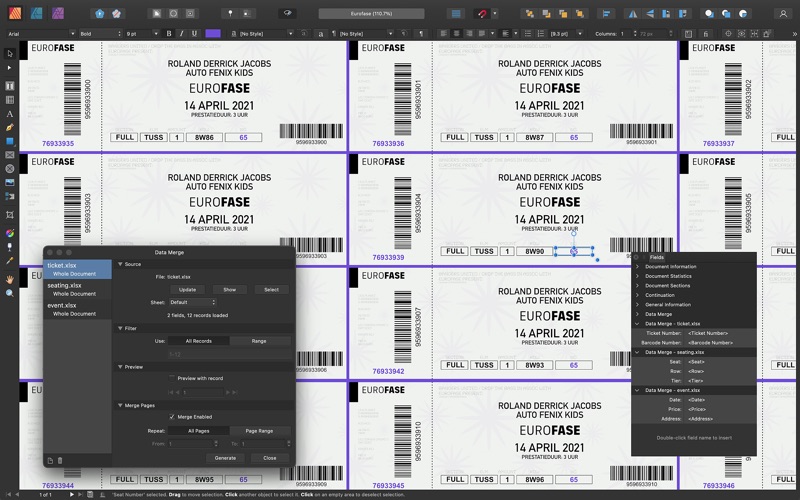
Even though the Publisher imitated some of the InDesign’s features, it improved the overall usability of a program, with the use of the vital commands available right at your fingertips.
Asset Panel
Publisher’s assets panel is an attractive feature for many users. You can choose between different pre-made vector icons, which you can simply drag into your designs. This feature can improve and fasten your design process.
Should You Consider Switching to Affinity Publisher?
If creating magazines, brochures, and other print media daily, Affinity Publisher is brilliant software to use. It has an impressive interface, enough capacity to deal with the complicated task, and has a unique attributes list.
It is also part of the StudioLink, which is one of the most noteworthy things Serif has created. It enables you to alter photographs, make vectors, and create page breaks inside one application.
Best fit for Publisher would be a freelance graphic designer or small designer team, and if you are one of the two you should consider shifting from InDesign.
Despite being a new player in the publishing business, it is still a professional-grade all-in-one publication tool, that will definitely suit all your needs.
On the other hand, if you work in an environment where everyone uses Adobe InDesign, switching to Affinity Publisher most likely isn’t the right choice.
The Publisher Needs Some Essential Nuts and Bolts
When the software was in sill in a Beta form, developers were collecting users feedback to make necessary improvements for the final version. However, there are still some specific features missing, which might be quite unfavorable for some users.
For example, if you want to make a three-fold brochure where you put together three spreads one next to another, you can, for now, forget about it.
Another thing that you can not make with Publisher are interactive presentations, and if you make a lot of those, I suggest you stick with the InDesign for now because Serifs said that they are not planning to take any steps in that direction.

Affinity Publisher Cost
Farewell to Adobe InDesign?
Publisher covers print and in some way also web design, besides it’s made for both Windows and Mac operating system. You will be able to create single or multi-page documents, books, brochures, and magazines with ease, and if you’re looking for processing speed, power, and flexibility, the Publisher is the ideal choice for you.
Before purchasing Publisher, be sure to check out how long your Adobe subscription lasts, so you won’t be stuck with two programs that do the same job.
Final Words: Affinity Publisher Vs Adobe InDesign
With the one-off payment of $49.99 Publisher is an excellent choice if you’re looking for an InDesign substitute, which runs at $239,88/yr, besides being a cheaper alternative Serif also offers free updates on all their programs.
Even though Affinity Publisher is not perfect yet, developers are listening carefully to the design community and are developing new tools that will come with future updates, besides that they are trying to make the program runs smoothly as possible, without any crushes.
If you’re still on the fences, try the Publisher trial version, test it out, and it might convince you to dump InDesign for good (I know I did).
If you’re interested in other Affinity products, you can also read my review about Affinity Designer vs. Adobe Illustrator here on DesignyUp.
Affinity Publisher Cost Calculator
You Might Also Like...
Is Affinity Publisher Any Good